
Event. On 28 February, the United States and Israel launched a major coordinated military offensive against Iran, described as “Operation Epic Fury” or Operation ‘’Lion’s Roar’’ respectively. The strikes targeted a wide range of Iranian military infrastructure and leadership sites in Tehran and other cities. Iranian state media confirmed that Iran’s Supreme Leader, Ayatollah Ali Khamenei, was killed in the attacks. Major cities struck included Tehran, Isfahan, Qom, Tabriz and Kermanshah, and significant explosions were observed across the country. In response, Iran has targeted multiple locations using missiles and drones in Israel, Jordan, Iraq and neighbouring Gulf Cooperation Council (GCC) countries including Qatar, Kuwait, the UAE, Bahrain and Oman. Airspace closures are widespread with most airlines suspending flights across the region. In the maritime domain Iran has attempted to destabilise the flow of shipping through the Strait of Hormuz with increased electronic interference reported and vessels being hailed on VHF by Iranian forces.
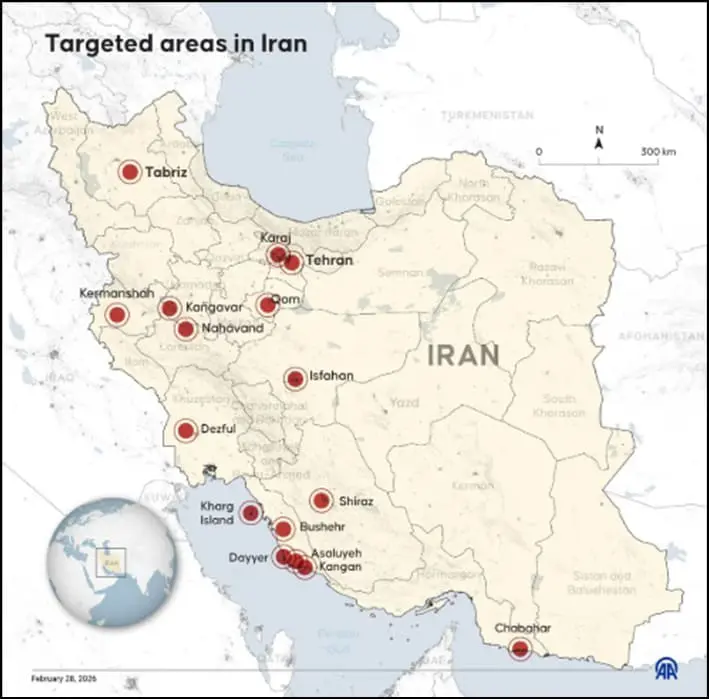
Fig 1. Location of Iranian cities target by the US and Israel.
Comment. Iran has focussed its retaliation on US military bases and Critical National Infrastructure (CNI such as ports and airports) in the region in countries it believes are supporting or facilitating US and Israeli military activity. However, Iran has also carried out indiscriminate attacks on civilian infrastructure including hotels, airports and iconic structures such as the Burj Al Arab in Dubai. While air defences in GCC countries have been largely effective, there has been collateral damage in many areas due to falling debris.
Iran has also attempted to destabilise the flow of shipping in the Arabian Gulf and Strait of Hormuz (SOH) by increasing electronic interference affecting ships navigation aids and is also contacting ships by VHF to claim the Strait of Hormuz is closed. It has been reported today that a Palau-flagged tanker and at least three other commercial ships have been struck by an unknown projectiles, there are no reports of casualties. It is likely many ships will return to port of origin or divert routes to avoid the situation. Ports in the Oman at Salalah and Duqm have come under attack. There are multiple airport and airspace closures across the region, people visiting on business or on holiday particularly in the UAE and Qatar and are likely to be stranded for some time.
It now remains to be seen how the death of the supreme leader will play out in Iran. The US and its allies hope it will lead to regime change but Iran is historically resilient to such events and the government has initiated the search for a new leader. The regime has vowed to continue to fight and resist further US and Israeli strikes on its territory but it remains to be seen how long its limited stocks of defensive and offensive weapons can last.
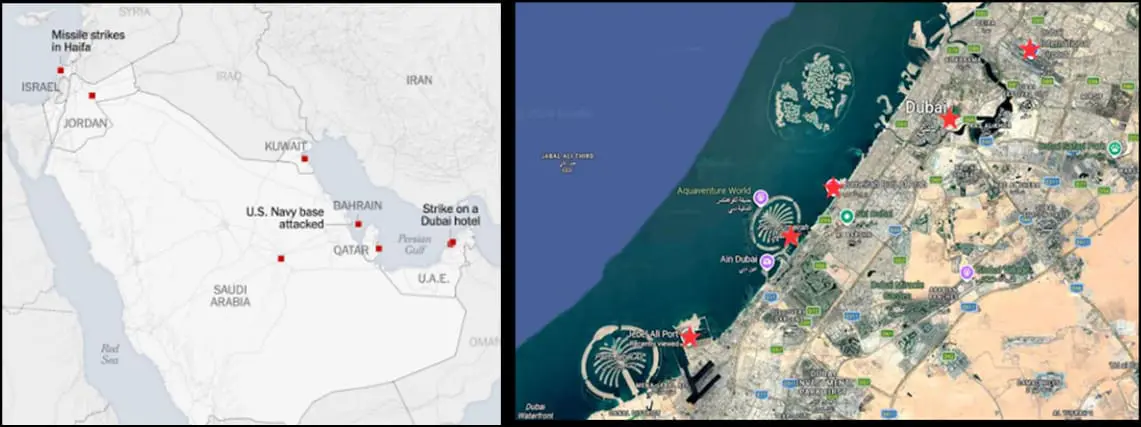
Fig 2. Location of Iranian Drone strikes in GCC Countries and Dubai.
Assessment. It is likely there will be a cycle of strike/counterstrike across multiple theatres in the coming days. Iran will continue to conduct retaliatory attacks using missiles and drones. It is unlikely the US and Israel will resort to a ‘boots on the ground‘ invasion scenario but instead will hope that regime change will take place initiated by a either a civil uprising or by factions within the government who are sympathetic to a more moderate society which could also see the return of Reza Pahlavi, the exiled son of Iran’s last monarch. Now the US/Israel has removed the supreme leader and much of Iran’s Command and Control elements, it is likely to switch its focus to attacking Iranian air defence systems and missile infrastructure. Iran’s government may adopt a ‘backs to the wall’ stance and aim to inflict maximum damage using the full force of its remaining ballistic missile stockpile on its perceived adversaries throughout the Gulf region and further afield, and attempt to influence them to put pressure on the US/Israel to stop its activity.
In the maritime domain it is highly likely Iran will increase its rhetoric and kinetic activity regarding threats to close the Strait of Hormuz, applying pressure on ships attempting to leave or enter the Arabian Gulf. It is possible that Iran may lay mines or attack more ships transiting the SOH with drones or missiles. In response the US and its allies are likely to increase its naval presence in the SOH. Even without a “formal” closure, the practical outcome will result in slowed traffic flow, hesitation from ship operators, and higher risk pricing. During the next 48 hrs it is likely there will be a surge in war risk premiums, Ship operators should consider rerouting their vessels at this time of heightened threat. Vessels should also strengthen bridge watches, maintain enhanced visual and radar lookout, and ensure all crew are briefed on the developing threat picture. Given the increasing likelihood of GNSS/GPS degradation, Masters should place greater reliance on traditional navigation methods and frequent manual cross‑checks. Operators are advised to conduct Vessel Affiliation Checks prior to entering high‑risk areas to identify any links that could elevate exposure. Emergency communications and response plans should be reviewed and confirmed, with redundancy in place should primary systems be disrupted. Finally, routing should remain flexible, with Masters prepared to adjust transit timings, speed, or track at short notice as the regional situation continues to evolve.
Employee duty of care. Advice for employee duty of care in the land and maritime domains are below.
SAFETY GUIDANCE AND RESPONSE TO CONFLICT INCIDENTS ON LAND AND IN THE MARITIME DOMAIN
- Land based incidents. The UAE Government has provided the following guidance in response to missile and drone attack.
What to do during missile blasts and alerts (first 60 seconds)
- Get inside as fast as possible. The biggest risk is from glass, debris and shrapnel
- Move away from windows and go to an interior room such as a windowless closet or bathroom or central corridor
- Get low and protect your head, sit or lie on the floor use a pillow or blanket to cover yourself.
- Do not go onto balconies or rooftops
- Stay where you are until there is an official update or all-clear declared. Do not self-evacuate to the street unless authorised or instructed to do so.
Specific Situations
- If you are in a high-rise building, go deeper inside the unit (central hallway)
- Avoid elevators during an active incident
- Close curtains or blinds if it is safe to do so. This reduces glass scatter
- If you are outside, go into the nearest solid building
- Avoid glass facades, glass canopies and open promenades
- If you are driving, if you hear blasts or receive an alert, pull over and get into the nearest building if possible
- If you cannot exit the car safely, stop and duck below the window line
- Avoid stopping near fuel stations. Bridges, overpasses and crowds
After Blasts or Interceptions
- Assume debris is dangerous. It can be sharp, hot or potentially dangerous
- Do not touch debris and do not approach it
- Do not attempt to take close up photographs
- Create a perimeter, keep children and bystanders away
- Report it to authorities
- Call and Ambulance if anyone is injured
- Maritime Guidance. The Joint Maritime Information Center (US Navy) has published the following information and advice.
Operational Environment
The security environment in and around the Strait of Hormuz is SIGNIFICANT due to ongoing regional military operations. Mariners should expect increased naval presence, enhanced force protection postures, potential VHF hailing, congestion near anchorage areas outside the Strait, and insurance market volatility. Due to ongoing military operations shipping company are advised to carefully assess risk before transiting the SOH.
To mitigate the risks, Masters should consider:
- Continuous VHF Channel 16 watch
- AIS transmission according to company policy
- Strict adherence to traffic separation schemes
- Immediate reporting of unusual activity to recognized reporting centres
If a formal closure were to occur
In the event a formal closure or exclusion zone is declared, duration and impact would depend on several variables, including:
- Whether the restriction is politically declared or physically enforced (e.g., mining, missile threat posture).
- The scale and coordination of multinational naval presence.
- The scope and geographic precision of any exclusion zone.
- Diplomatic engagement between regional and international stakeholders.
- Market response and insurer risk thresholds.
