
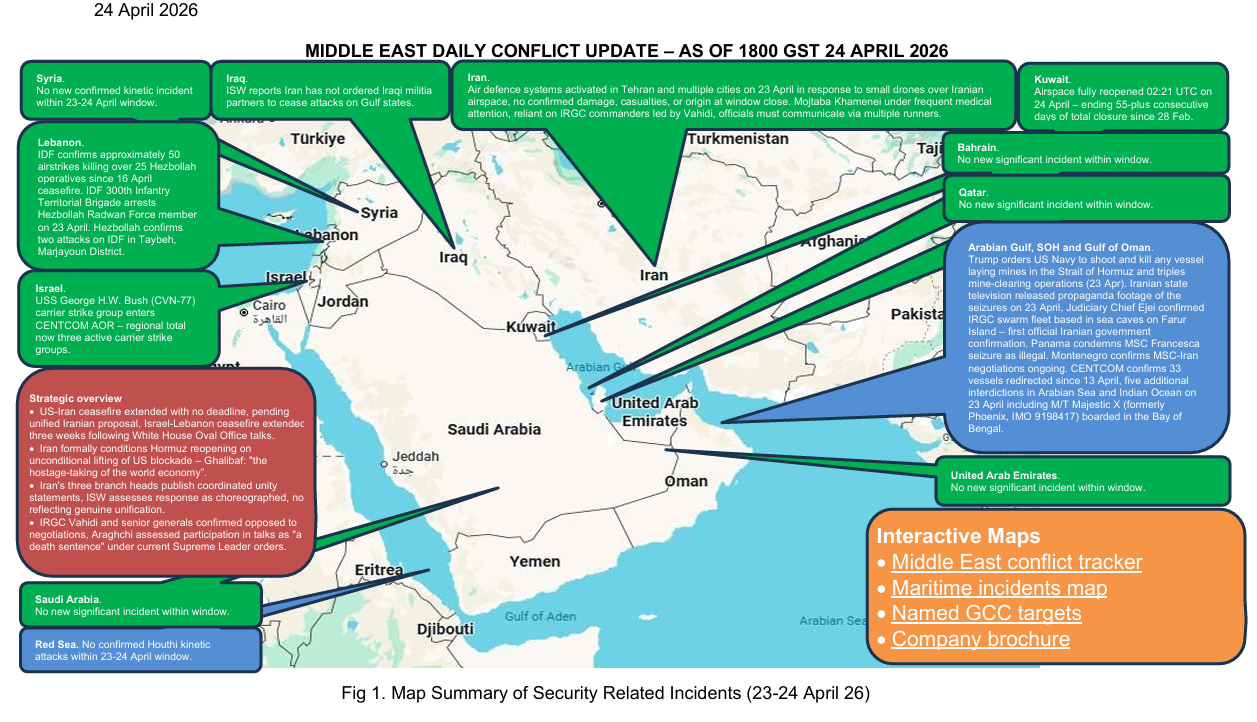
Headlines. The open-ended US–Iran ceasefire continues to hold, but underlying tensions remain unresolved, with the Strait of Hormuz at the center of heightened maritime risk. US naval posture is intensifying as Iran maintains firm conditions for reopening the waterway, keeping the maritime threat environment at a critical level despite limited kinetic activity. Internal divisions within Iran are complicating prospects for negotiation, while proxy activity and broader regional instability persist beneath the surface of the truce. At the same time, multinational planning for potential security operations is accelerating, energy markets are reacting sharply to ongoing uncertainty, and commercial shipping continues to face disruption—leaving the overall outlook defined by fragile stability and a high risk of escalation.
For your bespoke by country update, more information on current events, and, safety and security advice, download Neptune P2P’s Middle East Conflict Daily Security Intelligence Report.
Explore our interactive tracker Neptune ME Conflict Tracker — a real‑time intelligence dashboard showing cumulative conflict indicators, regional disruption and operational impact across the US–Israel–Iran escalation (mobile users use landscape).
Explore our interactive map of Iranian‑named GCC infrastructure targets here: Named GCC Targets (mobile users use landscape).
For real‑time awareness of maritime incidents, track developments using Neptune P2P Group’s interactive Maritime Incident Map, covering the Arabian Gulf, Strait of Hormuz, and Gulf of Oman: Maritime Incident Map — Arabian Gulf / SoH / GoO
To learn more about our capabilities and services, view the Neptune P2P Group Company Brochure here: Neptune P2P Group – Company Brochure 2026
