
Event. Armed assailants stormed several churches in Kurmin Wali village, Kaduna State, on 18 January 2026, seizing over 170 congregants during services and issuing ransom demands for motorcycles and cash. Victim Afiniki Moses, freed from a prior abduction after ransom payment, endured further trauma as her husband was taken in this raid, exemplifying the relentless cycle of abductions and violence. Initial police denials gave way to confirmation under pressure, while nearby military actions rescued some hostages, this fails to resolve the crisis, amplifying calls for urgent government intervention.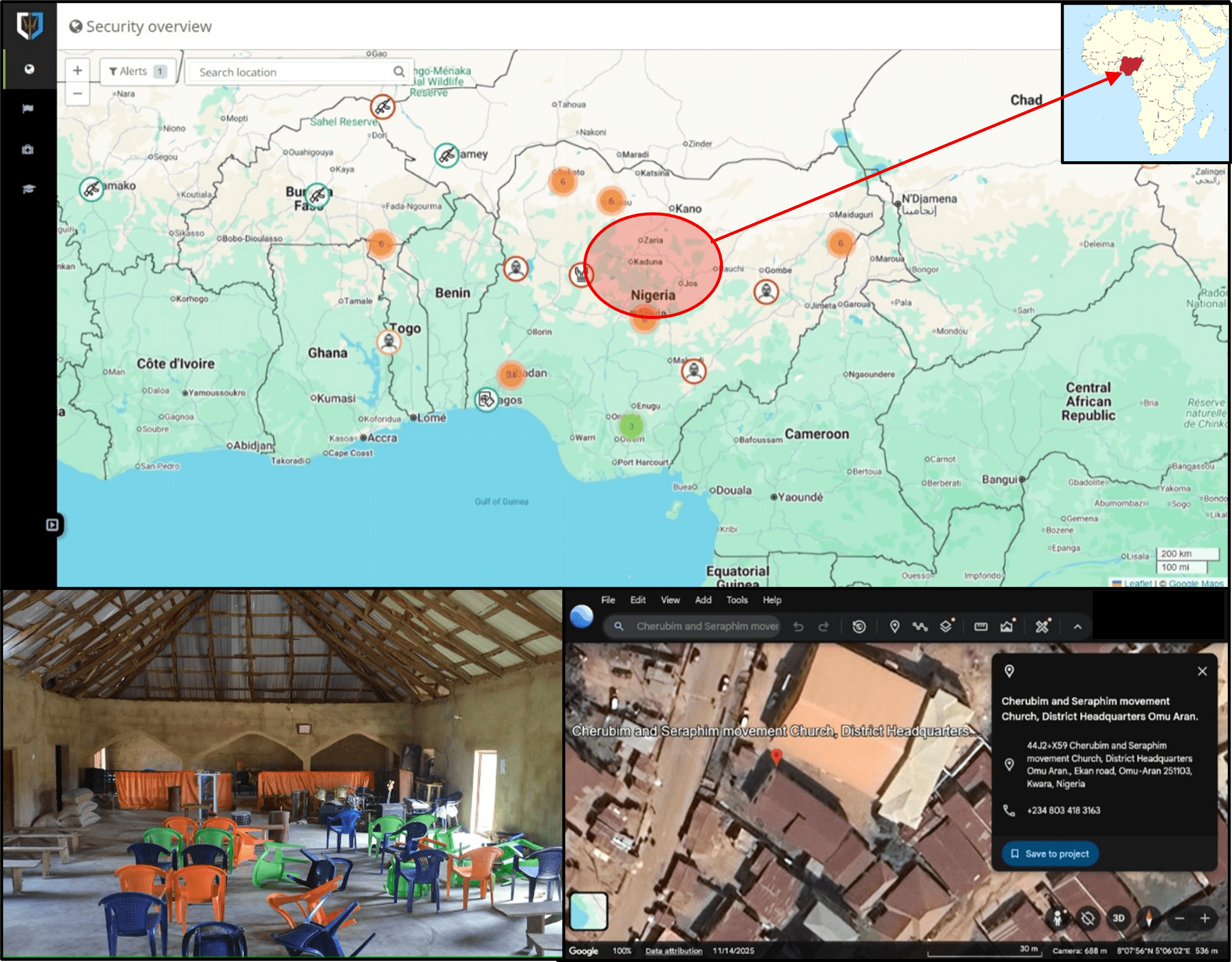
Figure. Satellite and Interior view of Haske Cherubim and Seraphim Movement Church following the attack (Google Earth/Reuters); Nigeria security overview with highlighted incident area map and Africa inset (Neptune’s TRM app).
Comment. The raid has resulted in at least 163 hostages held captive as of 26 January 2026, with ransom calls surpassing N28 million ($c.$20,000). The preceding year witnessed over 4700 abductions nationwide in that extracted N2.57 billion (c.$1.83 million) in payments. In addition to the Nigeria’s endemic abductions, its central belt grapples with intercommunal strife, including Fulani herder-farmer conflicts displacing thousands in Plateau and Benue States, often escalating into deadly reprisals with hundreds killed annually. The northeast contends with Boko Haram and the Islamic State West Africa Province (ISWAP) insurgencies, where clashes claimed 200 lives recently and humanitarian needs affect 5.9 million in Borno, Adamawa, and Yobe States. North and northwest areas suffer from criminal banditry involving up to 30,000 perpetrators, responsible for 62 per cent of kidnappings in hotspots like Zamfara and Katsina through raids and rustling. Southeast and south-south threats tie to oil and gas criminality, with Independent Persons of Biafra (IPOB)-led sit-at-homes inflicting N19.6 billion (c.$14 million) in weekly economic losses, compounded by cultism and piracy in the south-south Niger Delta leading to maritime abductions. Kidnap for Ransom spans the country, recording 997 incidents abducting 4,722 individuals and demanding N48 billion (c.$34 million), while additional perils include urban crime, communal clashes, and piracy fuelling over a reported 600,000 conflict-related deaths in recent years. This entrenched insecurity disrupts vital business hubs, stifling investment and naturally compelling firms to reinforce protections for their personnel.
Assessment. Nigeria’s security landscape is deeply undermined by root causes such as widespread poverty fuelling desperation and crime, compounded by inadequate governance that leaves vast areas without effective state presence. This fosters general lawlessness where armed groups and criminals operate with impunity; exacerbated by systemic corruption eroding trust in institutions. Despite these challenges, with a vast population exceeding 200 million offering a substantial workforce and consumer base, alongside potential for robust economic growth in sectors like oil, agriculture, and technology there should be opportunities abound if stability improved. To capitalise on such prospects while conducting business, organisations must undertake thorough due diligence to evaluate partners, locations, and regulatory environments beforehand. Once operating, robust business continuity and resilience frameworks are essential, aligning with standards like ISO 22301 through contingency plans that address disruptions from violence to supply chain failure. For personnel, travel risk management becomes critical, incorporating ISO 31030 guidelines with control measures such as pre-travel assessments, secure transport arrangements, real-time monitoring, mandatory briefing and training, and emergency evacuation protocols, all to uphold duty of care and mitigate financial liabilities from incidents, reputational damage, or legal claims.
