
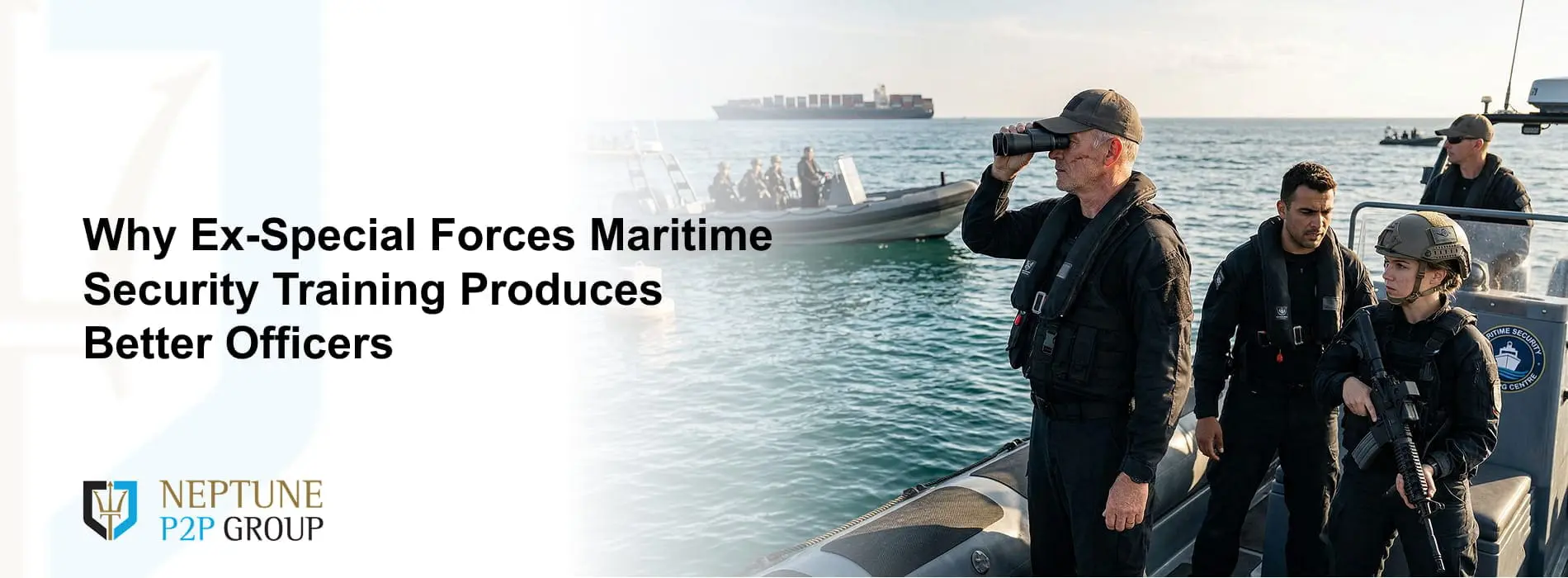
Introduction: Why Training Pedigree Matters in Maritime Security
In the UK maritime security market, the question of where security officers receive their training carries significant weight. British buyers — from port operators and shipping companies to corporate security managers and fleet managers — understand intuitively that the quality of training has a direct and measurable impact on operational performance. They have seen, both in the military and in the security industry, the difference that elite training methodology makes to the decision-making, composure, and effectiveness of security personnel under pressure.
This is particularly true in maritime security, where the threat environment is unpredictable, the legal framework governing the use of force is complex, and the consequences of a poor decision — whether at a port terminal or on a vessel transiting a high-risk corridor — can be irreversible. The question of whether a security officer can maintain composure, make sound tactical decisions, and operate within the law in the most demanding circumstances is not an abstract one. It is the central competency question that every maritime security training programme must answer.
Neptune P2P Group’s answer to this question is rooted in its heritage as a company founded and operated by former British and French Special Forces personnel. This article explains why that pedigree matters and what it means for the quality of maritime security training delivered to UK clients.
1. What Special Forces Training Actually Develops
British Special Forces selection — whether for the Special Air Service (SAS), Special Boat Service (SBS), or the broader UK Special Forces (UKSF) community — is the most demanding military selection process in the world. Of those who attempt selection, the majority fail. Those who pass are not simply physically capable; they have demonstrated the psychological resilience, decision-making quality under extreme stress, and the capacity to apply complex professional judgement in conditions of uncertainty that define elite operational performance.
The training that follows selection reinforces these qualities through years of sustained operational exposure: counter-terrorism operations, hostage rescue, maritime interdiction, close protection for heads of state and high-value individuals, and intelligence-led operations in the most contested environments on the planet. The competencies developed through this experience — threat assessment, surveillance awareness, use of force judgement, team leadership, emergency medical response, and cultural intelligence — map directly onto the demands of professional maritime security.
| The Difference: A security officer trained by former Special Forces is not simply taught procedures. They are trained to think — to assess threats dynamically, to apply proportionate responses to escalating situations, and to make sound decisions in the absence of a supervisor. This is the cognitive and tactical standard that Neptune P2P Group’s training academy brings to maritime security training in the UK. |
2. How Special Forces Methodology Shapes Training Design
Scenario-Based Learning
Special Forces training is fundamentally scenario-based. Rather than teaching procedures in a classroom and hoping they transfer to real environments, SF training methodology places students in realistic, complex, often ambiguous scenarios that require them to apply multiple competencies simultaneously under time pressure and stress. Neptune P2P Group’s maritime security training programmes incorporate this methodology — trainees are tested not in how well they can recite the ISPS Code, but in how effectively they can apply its requirements when the situation on the ground is messy, ambiguous, and time-critical.
Red Teaming and Threat Modelling
Special Forces operators are trained to think like the adversary. This adversarial thinking — known as red teaming — is a core methodology in Neptune P2P Group’s security training programmes. Rather than training security officers purely to implement defensive procedures, the training develops their understanding of how port facilities and vessels are targeted, what vulnerabilities are exploited by sophisticated adversaries, and how to identify indicators of hostile surveillance and pre-attack activity. This perspective transforms a procedural compliance officer into a genuine security professional.
Use of Force and Rules of Engagement
Perhaps the most critical competency area in maritime security training — and the one where the gap between average training and SF-standard training is most significant — is the use of force. The legal framework governing the use of force at sea is complex, jurisdiction-dependent, and requires security officers to make real-time judgements that are defensible in both criminal courts and regulatory proceedings. Special Forces operators are trained from the start of their careers to apply the use of force within strict legal frameworks in dynamic, contested environments. This is a competency that cannot be adequately developed in a classroom in three days. It is built through years of operational experience and reinforced through rigorous scenario training.
Emergency Medical Training
Tactical emergency medical care — the ability to provide effective first aid in a hostile environment where conventional medical support is unavailable — is a core SF competency. Neptune P2P Group’s maritime security teams are trained to a standard that significantly exceeds the basic first aid requirements of standard maritime security training programmes. For vessels operating in remote high-risk environments, the security team’s medical capability may be the difference between life and death for an injured crew member.
3. What This Means for UK Maritime Security Training Buyers
For UK port operators, shipping companies, and corporate security managers evaluating maritime security training providers, the following questions are the most effective way to assess the quality and credibility of a training programme:
- Who are the instructors and what is their operational background? Neptune P2P Group’s instructors are former British and French Special Forces personnel with extensive operational maritime security experience. This is verifiable and forms the foundation of our training methodology.
- Is the training scenario-based or primarily procedural? Effective maritime security training must test students in realistic scenarios, not just examine knowledge of the ISPS Code. Ask for details of the practical elements of any training programme.
- Does the use of force training reflect current case law and the BMP MS framework? Rules of engagement training must be current, legally accurate, and taught by instructors who have applied use of force decisions in real operational environments.
- Is the training accredited and compliant with UK regulatory requirements? Neptune P2P Group’s maritime security training programmes meet the requirements of the MCA (Maritime and Coastguard Agency), IMO model course standards, and ISPS Code compliance requirements.
4. Neptune P2P Group’s Maritime Security Training Portfolio — UK
Neptune P2P Group’s ex-Special Forces instructors deliver ISPS-compliant maritime security training in the UK. SSO, CSO, PFSO, SAFE, and HEFAT courses available. Our training academy, based in Manchester, delivers a comprehensive portfolio of maritime security training courses designed for port operators, shipping companies, fleet managers, and aspiring maritime security professionals:
- Ship Security Officer (SSO) Course: MCA and USCG approved. Equips vessel security officers with the competencies required by STCW Table A-VI/5 and the ISPS Code.
- Company Security Officer (CSO) Course: For fleet security managers and maritime operations managers with company-level ISPS responsibilities.
- Port Facility Security Officer (PFSO) Course: 3-day ISPS-compliant training for port and terminal security officers. Covers PFSA methodology, PFSP development, and UK DfT compliance requirements.
- Security Awareness in Foreign Environments (SAFE): For vessel crew, shipping company employees, and maritime professionals operating in high-risk environments.
- Hostile Environment and First Aid Training (HEFAT): For maritime security professionals and vessel crew deploying to conflict-adjacent or high-risk environments.
Conclusion: The Standard You Train To Is the Standard You Perform To
In maritime security, the quality of training is not an abstract consideration — it is the primary determinant of operational performance when it matters most. The decision-making quality, composure under pressure, use of force judgement, and emergency medical capability of a security officer in a critical incident are direct products of the training they have received.
Neptune P2P Group’s Special Forces heritage is not a marketing credential. It is the foundation of a training methodology that has been tested and validated in the most demanding operational environments in the world, and which we apply to the development of maritime security professionals who are required to perform to the highest standard in the most challenging maritime environments on the planet.
About Neptune P2P Group
Neptune P2P Group is a global security risk solutions company founded in 2009 and owned by former British and French Special Forces personnel. With over 8,500 completed security tasks across the AMEA region and a 100% success record for anti-piracy operations, Neptune P2P Group delivers maritime security services, ports and terminal security, protective security, maritime security training, and travel risk management to shipping companies, port operators, corporations, and governments worldwide.
