
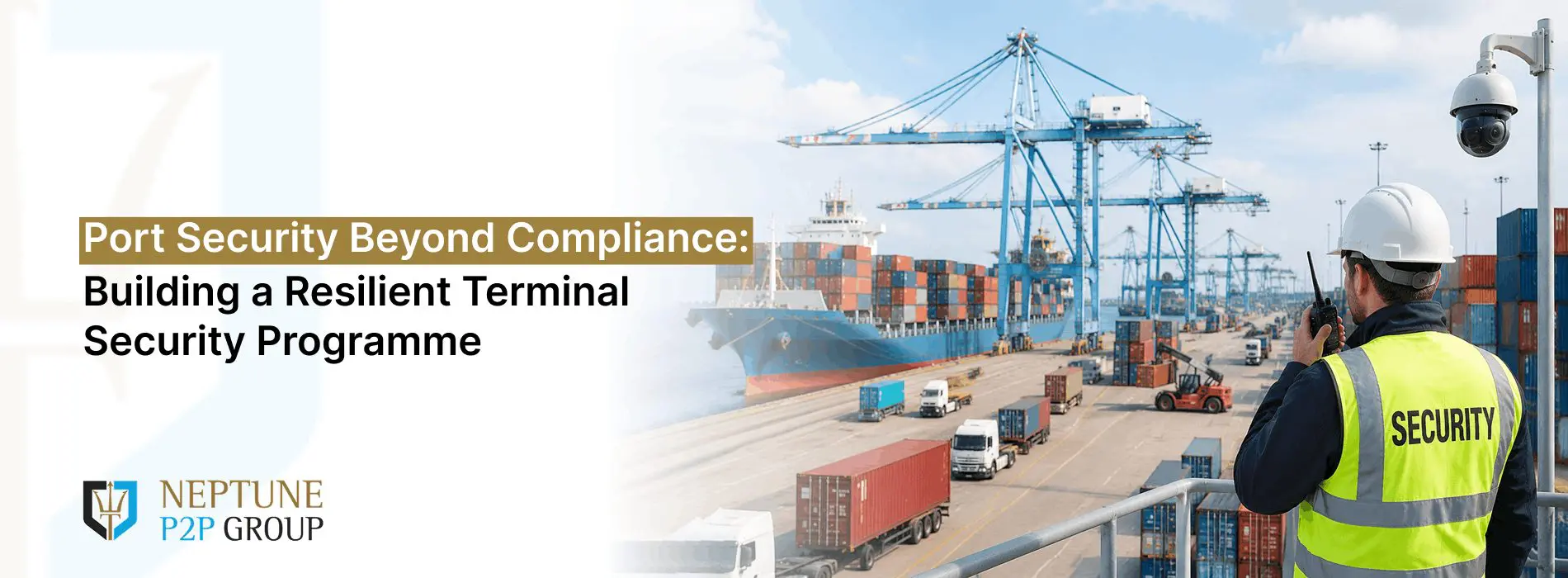
Every designated UK port facility operating under the ISPS Code has a Port Facility Security Plan, a qualified Port Facility Security Officer, and a documented security assessment. These are not optional — they are legal requirements enforced by the Department for Transport. But compliance with ISPS obligations, as important as it is, represents only the minimum standard. It describes a security floor, not a security ceiling.
The ports and terminals that are genuinely resilient to the security threats of 2026 — terrorism, organised crime, cyber attack, insider threat, and the convergence of all four — are those that treat their ISPS compliance framework as the foundation for a broader, more proactive security programme that goes significantly further than the regulatory minimum.
This article is for port directors, terminal managers, and security managers in the UK who want to understand what a truly resilient terminal security programme looks like in practice — and how Neptune P2P Group’s Ports and Terminal Security UK services can help build it.
1. The UK Port Security Threat Landscape in 2026
UK ports face a more complex security threat environment in 2026 than at any point since the ISPS Code came into force. The elevated national terrorism threat level — currently assessed at Substantial by MI5 — is one dimension. But UK port security professionals must also contend with:
- Organised crime and smuggling: UK ports are major entry points for the smuggling of class A drugs, weapons, and human beings. The criminal networks involved are sophisticated, well-resourced, and capable of corrupting port security personnel to facilitate their operations. The National Crime Agency identified UK port vulnerabilities as a top-tier concern in its 2025 Serious and Organised Crime threat assessment.
- State-sponsored sabotage: The UK government’s 2025 Integrated Review update identified deliberate interference with critical national infrastructure — including ports — as a priority threat from hostile state actors. Ports handling energy commodities, defence logistics, or strategic imports face a particular exposure in this category.
- Cyber attack on port operational systems: Port operational technology — including vessel traffic management, cargo tracking, access control, and crane automation systems — represents a high-value target for both state-sponsored and criminal cyber adversaries. A successful cyber attack on a major UK container terminal could disrupt supply chains with economic consequences running to hundreds of millions of pounds.
- Insider threat: The diversity of the port workforce — spanning permanent employees, agency workers, contractors, and logistics providers — creates a large and complex insider threat surface. A single compromised individual with access to a restricted area or a security system can create a vulnerability that negates millions of pounds of physical security investment.
2. What Compliance-Only Security Misses
ISPS-compliant security plans are built around a set of defined threat scenarios and a prescribed set of security measures. This framework was designed in 2002 and has been updated periodically, but it cannot be expected to address every dimension of the 2026 threat environment — particularly the rapidly evolving cyber and hybrid threat landscape.
The gaps most commonly identified in Neptune P2P Group’s port security assessments of UK facilities include:
- Cyber security integration: ISPS compliance frameworks do not mandate specific cyber security measures for port operational technology. Many UK terminals have comprehensive physical security plans but lack any systematic assessment or hardening of their OT systems.
- Insider threat programme: ISPS plans address access control and restricted area management but typically do not include a structured insider threat awareness and detection programme. The absence of one leaves a significant vulnerability unaddressed.
- Supply chain and contractor vetting: ISPS-compliant facilities typically screen their own permanent personnel but apply inadequate vetting to the large number of contractors, logistics providers, and transient workers who regularly access restricted areas.
- Security exercise realism: ISPS requires periodic security drills, but these are frequently conducted against scenarios that are either too simplistic or too well-known to the participants to generate meaningful learning. Realistic, no-notice exercises against credible threat scenarios produce significantly better outcomes.
- Drone threat: The use of unmanned aerial vehicles to conduct surveillance of port facilities, facilitate smuggling operations, or potentially deliver a payload is a rapidly growing threat that predates most existing ISPS compliance frameworks.
3. Building a Resilient Terminal Security Programme
Layer 1: Intelligence-Led Threat Assessment
Resilient port security begins with an intelligence-led understanding of the specific threats facing your facility. This requires more than a periodic review of national threat level assessments. It requires a structured programme of intelligence collection and analysis that is specific to your port, your cargo profile, your workforce, and your location — updated continuously as the threat environment evolves.
Neptune P2P Group’s intelligence team provides port operators with tailored threat assessments, monthly intelligence reports, and incident alerts that give security managers the current picture they need to make proactive security decisions rather than reactive ones.
Layer 2: Physical Security Excellence
Physical security measures — perimeter fencing, access control, CCTV, lighting, secure areas — must be designed and maintained to a standard that reflects the threat assessment, not just the ISPS minimum. This means regular testing of physical security measures, including penetration testing by experienced security professionals who can identify vulnerabilities that are invisible to in-house teams.
Layer 3: Personnel Security and Insider Threat
The most effective physical security investment can be rendered worthless by a single insider. A robust personnel security programme covers background vetting for all staff with access to restricted areas, structured security awareness training, clear reporting channels for suspicious behaviour, and a management culture that takes security concerns seriously. Neptune P2P Group’s BCR advisory includes insider threat assessment as a core component.
Layer 4: Cyber and OT Security
Port operational technology systems must be assessed and hardened against cyber intrusion as part of an integrated security programme. This is not an IT department responsibility alone — it requires collaboration between port security management, IT, and operational teams, supported by specialist OT security expertise. Neptune P2P Group’s security risk management advisory encompasses cyber security awareness as a component of its Business Continuity and Resilience service.
Layer 5: Crisis Management and Emergency Response
No security programme is complete without tested plans and trained personnel for responding to incidents when preventive measures fail. Crisis Management and Emergency Response planning for UK ports must cover the full spectrum of credible scenarios — from a suspicious package or vehicle incident to a terrorist attack, a cyber-induced operational failure, or a major maritime accident in the port approaches.
| Exercise Tip: Neptune P2P Group recommends that UK port facilities conduct a minimum of one major no-notice security exercise per year against a realistic, complex threat scenario — in addition to the ISPS-required drills. These exercises consistently reveal response gaps that scheduled drills miss, and provide the most valuable learning available to security teams short of an actual incident. |
| Ports and Terminal Security — UK
Neptune P2P Group provides security risk assessments, PFSO training, and security advisory services for UK port operators and terminal managers. Ports and Terminal Security UK — neptunep2pgroup.com |
Conclusion: Resilience Requires More Than Compliance
ISPS compliance is necessary but not sufficient for the security demands of 2026. UK port operators who treat compliance as the ceiling of their security ambition are leaving significant vulnerabilities unaddressed — vulnerabilities that sophisticated threat actors are actively seeking to exploit.
Neptune P2P Group’s Ports and Terminal Security UK advisory capability supports port directors and security managers in building resilient security programmes that go beyond ISPS compliance to address the full spectrum of threats facing UK port facilities in 2026. Contact our ports and terminal security team to discuss your facility’s requirements.
About Neptune P2P Group
Neptune P2P Group is a global security risk solutions company founded in 2009 and owned by former British and French Special Forces personnel. With over 8,500 completed security tasks across the AMEA region, Neptune P2P Group delivers maritime security, security risk management, protective security, training, and travel risk management services to shipping companies, port operators, corporations, and governments worldwide. Enquiries: neptunep2pgroup.com
