
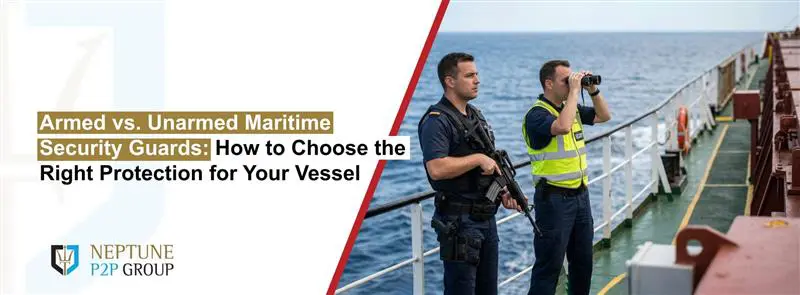
Introduction: A Decision That Affects Every Voyage
For fleet operators and ship managers in Japan, the question of whether to deploy armed or unarmed maritime security guards is one of the most consequential operational decisions they will make. Get it right, and your vessel transits high-risk waters with a credible, proportionate deterrent. Get it wrong, and you face either a dangerously under-protected vessel or a costly compliance problem with the Japanese flag state authorities.
Japan is home to one of the world’s largest commercial fleets. Japanese shipping companies manage thousands of vessels transiting some of the most threat-intensive maritime corridors on the planet — from the Singapore Strait and Malacca Straits, where piracy incidents reached historic highs in 2025, to the Gulf of Aden, Indian Ocean, and the Red Sea. In this environment, understanding the difference between armed and unarmed maritime security teams, when each is appropriate, and how Japanese law governs the use of privately contracted armed security personnel is not a theoretical exercise. It is a commercial and legal necessity.
This guide provides fleet operators, ship managers, and risk officers in Japan with a practical framework for making the right choice for each voyage and vessel type.
1. Understanding the Options: What Armed and Unarmed Security Teams Actually Do
Armed Maritime Security Teams (MSTs)
Armed Maritime Security Teams consist of vetted, trained security personnel who carry authorised firearms aboard the vessel for the duration of the transit through designated high-risk areas. Their primary function is deterrence — the visible and credible presence of armed guards has been demonstrated to be the most effective single measure in preventing pirate boardings. In the rare event that a piracy attempt proceeds despite this deterrent, armed teams provide the crew with a defensive capability to repel the attack.
Armed MSTs operate under strict protocols governing the use of force at sea, in compliance with international law, flag state regulations, and the Use of Force guidelines established by the industry’s Best Management Practices for Maritime Security (BMP MS). Team members are drawn from specialist military backgrounds — typically special forces, marine corps, or equivalent units — and are trained in firearms handling, rules of engagement, crowd management, and emergency medical response.
| Japan-Specific Requirement: Japanese-flagged oil tankers operating in designated piracy-infested waters may embark armed guards under the 2013 Japanese Ship Guarding Act (Law No.75). The Act sets strict vessel eligibility criteria — maximum speed of 18 knots fully loaded, freeboard under 16 metres, and the presence of a secure citadel. Armed guards are permitted on the high seas (beyond 12nm) but may only carry weapons within the territorial sea for embark and disembark purposes. |
Unarmed Maritime Security Teams
Unarmed maritime security teams provide vessel protection through a combination of deterrence, early warning, and hardening measures — without carrying firearms. Their value lies in enhancing the crew’s security awareness and implementing the physical and procedural protective measures outlined in BMP MS, including the operation of water cannons, razor wire deployment, citadel preparation, CCTV monitoring, and the maintenance of anti-piracy watches.
Unarmed teams are a legitimate and proportionate response in lower-risk environments where flag state regulations prohibit or restrict the embarkation of firearms, where port regulations at calling ports require vessels to be weapon-free, or where the specific nature of the voyage does not present a level of piracy threat that warrants armed protection.
2. The Threat-Based Case for Armed Protection
The decision to deploy armed or unarmed security should be driven primarily by a rigorous threat assessment of the intended route. The following key corridors currently present elevated threat levels relevant to Japanese fleet operators:
- Singapore Strait and Malacca Straits (SOMS): Over 70 piracy incidents were recorded in SOMS in 2025 — the highest figure since records began. Night-time transits of the eastbound lane present the greatest risk. Attackers are increasingly armed, and violence against crew is becoming more common. For slow-moving bulk carriers and tankers — the vessel types most targeted — armed MSTs provide the highest level of protection available.
- Gulf of Aden and Indian Ocean: Residual Somali piracy continues to represent a threat in the Northwest Indian Ocean, particularly for vessels operating outside established maritime security corridors. Armed MSTs remain the standard for transits through this corridor.
- Red Sea: The post-ceasefire return of some carriers to Red Sea routing does not eliminate the underlying risk. Houthi forces retain the capability to resume attacks. Armed MSTs in conjunction with specialist risk assessment are recommended for any vessel transiting this corridor.
- Gulf of Guinea: Kidnapping-for-ransom attacks remain the predominant threat in West Africa, with boarding teams often heavily armed. Armed MSTs are considered essential for tankers and offshore support vessels operating in this region.
| Key Principle: Armed protection is not a measure of last resort — it is the appropriate and proportionate response to an environment where attackers are themselves armed and prepared to use violence. For vessels transiting SOMS and other high-risk corridors, deploying armed MSTs is consistent with BMP MS guidance and the duty of care obligations of vessel operators to their crew. |
3. When Unarmed Security Is Appropriate
Unarmed maritime security is not a lesser option — it is the correct choice in specific circumstances:
- Flag state or port restrictions: Some flag states and port regulations prohibit the embarkation of firearms. If a vessel’s voyage plan includes calls at ports where weapons are prohibited, an unarmed team combined with enhanced physical hardening measures may be the operationally sound solution.
- Lower-risk transits: For vessels transiting routes where the threat level is assessed as low — for example, intra-Asian voyages within established port approaches — an unarmed team focused on security awareness, watch-keeping, and incident reporting may represent a proportionate and cost-effective response.
- Port security support: In port environments, unarmed security officers play a critical role in access control, surveillance, and ISPS compliance support — roles for which armed teams are neither required nor appropriate.
- Combination voyage profiles: Some voyages require armed teams for the high-risk ocean passage and unarmed teams at port calls or within territorial sea transits. Neptune P2P Group designs bespoke security packages that reflect the specific profile of each voyage.
4. The Japanese Regulatory Framework: What Fleet Operators Must Know
Japan’s approach to privately contracted armed security personnel (PCASP) is governed by the Special Measures Act for Security of Japanese Vessels in Pirate Infested Waters (2013), commonly referred to as the Japanese Ship Guarding Act. This legislation represented a significant step forward for the Japanese maritime industry, acknowledging that the threat environment in certain waters necessitates armed protection.
However, the Act’s scope is specific, and fleet operators must understand its parameters:
- Vessel eligibility: The Act currently applies specifically to Japanese-flagged crude oil tankers. Other vessel types — including LNG carriers, bulk carriers, and fishing vessels — may be brought within scope through cabinet-level Orders, but operators should confirm current eligibility before planning armed team embarkation.
- Operational area: Armed guards operate on the high seas beyond 12 nautical miles. Within the 12nm territorial sea, teams may carry weapons for the purposes of embarkation and disembarkation only — they may not use them.
- Compliance obligations: The Act imposes significant approval, reporting, and documentation requirements. Neptune P2P Group’s compliance team can guide Japanese operators through the full application process and ensure that all deployments are fully documented in accordance with the Act and its supporting Orders.
- Non-Japanese flagged vessels: Japanese shipping companies operating non-Japanese flagged vessels should comply with the flag state regulations of the relevant flag, which may have different requirements. Neptune P2P Group has experience across all major flag states and can advise accordingly.
| Compliance Advisory: Operating armed security teams without proper flag state authorisation exposes vessel owners to detention by port state control and potential prosecution. Neptune P2P Group ensures every armed team deployment is fully compliant with the applicable regulatory framework before embarkation. |
5. Practical Decision Framework: Armed or Unarmed?
The following framework provides fleet operators in Japan with a structured approach to the armed/unarmed decision:
- Step 1 — Route threat assessment: Identify the high-risk passages on the intended voyage. Reference the latest IMB Piracy and Armed Robbery Report, MSCI advisories, and ReCAAP ISC alerts for SOMS. Assess the threat level for each passage.
- Step 2 — Flag state and port compliance review: Identify any flag state restrictions on PCASP embarkation. Review calling port regulations for restrictions on the carriage of firearms. If armed teams are required and permitted, confirm eligibility under the Japanese Ship Guarding Act (for Japanese-flagged tankers).
- Step 3 — Vessel and voyage profile assessment: Consider vessel type, speed, freeboard, and cargo value. Slow, low-freeboard vessels carrying high-value cargo in high-threat areas present the strongest case for armed protection.
- Step 4 — Team specification: Define the number of team members, equipment requirements, and embarkation/disembarkation logistics. For longer voyages with multiple high-risk passages, consider how team handovers will be managed.
- Step 5 — Engage a specialist provider: Select a maritime security company with verified experience operating under Japanese flag state requirements, a track record in the specific threat environments on your route, and a 24/7 operations centre for real-time support.
6. Neptune P2P Group’s Maritime Security Services for Japan
Neptune P2P Group has provided maritime security services in Japan since 2009. With over 8,500 completed security tasks and a 100% anti-piracy success record, the company offers fleet operators in Japan a comprehensive range of vessel protection services, from armed and unarmed MSTs to voyage risk management, ISPS training, and 24/7 intelligence support.
- Armed Maritime Security Teams: Deployed to vessels transiting SOMS, the Indian Ocean, Gulf of Aden, Red Sea, and Gulf of Guinea. Teams are sourced from specialist military backgrounds and operate in full compliance with flag state regulations and BMP MS.
- Unarmed Security Teams: For lower-risk environments, port security support, and voyages with flag state or port restrictions on firearms.
- Vessel-based armouries: Pre-positioned at strategic locations across the AMEA region, enabling rapid deployment and reducing logistics lead times for Japanese fleet operators.
- Voyage security plans: Bespoke risk assessments, route planning, and security recommendations for each individual voyage.
- 24/7 Operations Centre: Real-time intelligence and incident response support for vessels at sea.
Conclusion: Making the Right Choice
For fleet operators and ship managers in Japan, the armed versus unarmed decision is ultimately a risk management question. It requires an honest assessment of the threat environment on the intended route, a clear understanding of the applicable regulatory framework, and a strategic view of the duty of care owed to the crew and the commercial obligation to protect cargo and schedule.
Armed maritime security teams provide the highest available deterrent against piracy and the most credible defensive capability in the event of an attack. Unarmed teams provide a proportionate and compliant response in lower-risk or restricted environments. In many cases, the optimal solution combines elements of both across the phases of a complex voyage.
Neptune P2P Group’s maritime security specialists in Japan are available to help you navigate this decision for every voyage.
About Neptune P2P Group
Neptune P2P Group is a global security risk solutions company founded in 2009 and owned by former British and French Special Forces personnel. With over 8,500 completed security tasks across the AMEA region and a 100% success record for anti-piracy operations, Neptune P2P Group delivers maritime security services, ports and terminal security, protective security, maritime security training, and travel risk management to shipping companies, port operators, corporations, and governments worldwide.
